How to plan a quiet dog walk in a busy neighborhood
A quieter walk starts on paper. Find the wide parts of your block, pick two places to turn back, and leave time for your dog to stop and look around.
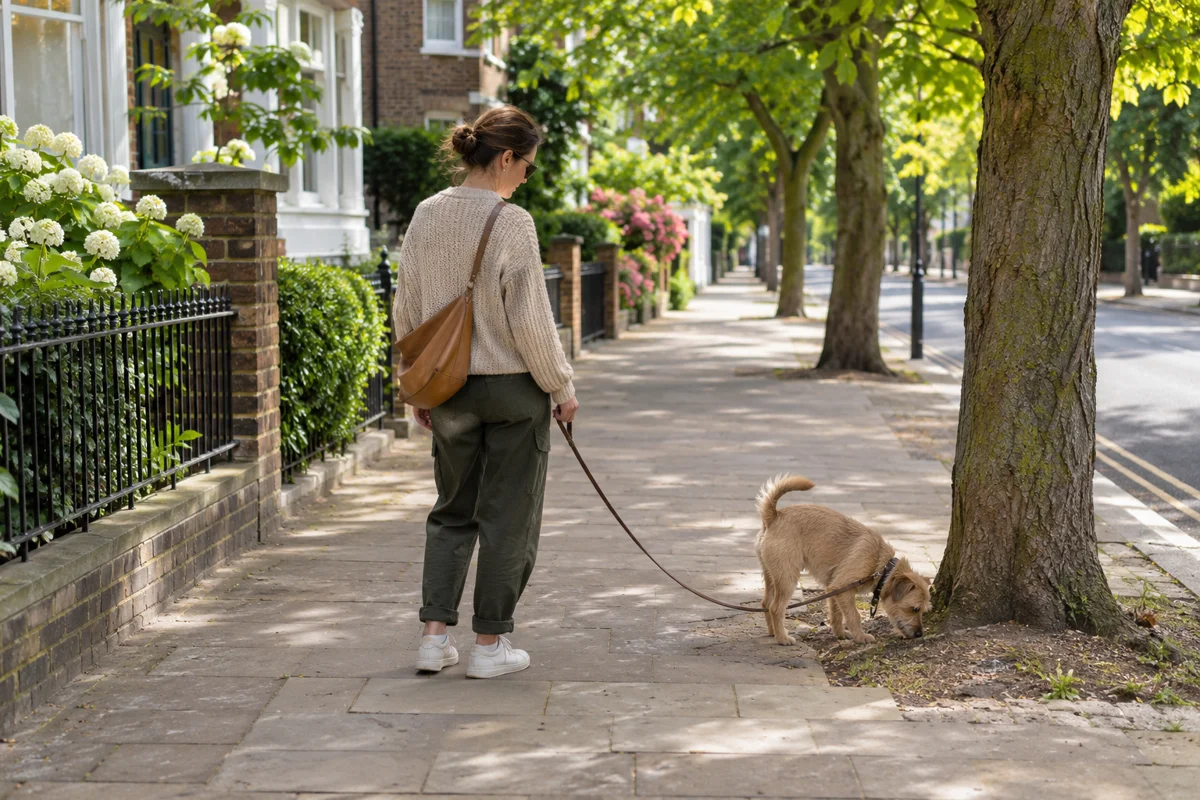
Walk the route by yourself first
Take ten minutes to look at the block without your dog. Start from the door you normally use and pay attention to places where you have few choices: a narrow path past a café queue, a blind corner beside a driveway, or a stretch with cars parked along both sides. Then look for the opposite kind of spot. A wide footpath, a safe crossing or an open corner gives you time to decide what to do if another person or dog approaches.
Draw a rough route with a starting point, one quiet place to pause, and two ways home. It can be the same pavement in both directions. An out-and-back route is useful because you can turn at any time. A loop asks you to finish the far side of the block even if the first half turns out busier than expected. Save the loop for a day when you know what to expect at both ends.
Look at the surface as well as the traffic. A long strip of grass can be a pleasant place to sniff, but it may also be crowded with people and dogs at certain times. A broad pavement beside quiet buildings might be more predictable. Look for broken glass, patches of sharp grit and construction debris. Cross at a safe point instead of trying to lead your dog through a hazard or along the road to avoid it.
Pick a time based on what happens on your block
The quietest fifteen minutes are often particular to a street. A residential stretch can fill up when a school lets out. A street of shops may be empty at dawn and noisy when the delivery vans arrive. Make a quick note of the busiest thing you notice and its time. It is easier to shift a walk by twenty minutes than to ask your dog to handle the same packed pavement every day.
Check visibility before you settle on an early or late route. A quiet street that is poorly lit may make it harder for either of you to see a cyclist or a car turning into a driveway. Choose crossings where you can see approaching traffic and where drivers can see you. If you wear reflective gear, check that it is visible beneath your coat and that a long lead cannot trail into a crossing. Keep one hand available for the leash and put your phone away before stepping off the curb.
Keep the first walk deliberately short
Use familiar gear and check the fastenings at home. If you have recently changed harnesses, do a short indoor fit check before testing it outside. Start by walking to the first place on the map where there is room to pause, then decide whether to go farther. Your dog may spend most of the time sniffing one tree or listening to activity across the road. That can still be a useful walk if both of you can stand comfortably without blocking a doorway or path.
Leave enough slack for the dog to move within the space you have. Shorten the distance before a crossing or when a narrow pavement gets crowded, then give the slack back once you have room. Watch what happens when the dog notices something ahead. A dog that glances at a passing bicycle and goes back to sniffing is giving you different information from a dog that freezes, stares or keeps pulling in the same direction. If the dog cannot settle, use one of the exits you marked and give yourselves more space.
Talk to other people early when you need room. A simple “We’re going to step back” is enough. If someone asks whether the dogs can meet, answer before they close the gap. The place to turn is usually the last wide spot you passed, so it helps to notice those spots as you walk. If you cannot safely cross, turn back on the same side instead of squeezing between parked cars or trying to wait in a doorway you do not control.
Use this example to test your own map
Suppose the first block has a busy bus stop on one corner, a broad pavement on the other, and a short stretch of grass halfway between. Start toward the broad pavement. When you reach the grass, stop far enough from the curb for the dog to move around comfortably. If the bus stop is filling up in the distance, turn around there. If it is quiet and you can see the next crossing clearly, go to the corner, pause, and return the same way. Either version uses the route you planned.
On a later walk, change one detail. Try the same route at a slightly different time, or add the far side of the block while keeping the time the same. That makes it easier to tell what helped. Adding a new street, a new harness and a new routine all at once leaves you guessing if the walk feels harder. If two people share walking duty, agree on the turnaround spot and write it down so both people use the same starting route.
Keep notes that help on the next walk
Write three things after you get home: where you went, what caused you to change direction, and where the dog could relax again. There is no need for a detailed journal. “Turned back at the delivery ramp, relaxed by the tree” is enough to decide whether to try a different time or remove the ramp section. Note whether the weather changed the route, too. A breezy day can make a normally quiet street noisier, and a rainy day can push more people under a narrow awning.
Give the plan a second route for days when the first one is blocked. That can be a short stretch in the other direction with a reliable place to turn. It helps if the backup is just as easy to reach from the door. Keep an indoor sniffing game in mind for days when a normal outing is difficult, and use the shorter outside trips your dog still needs. If a dog regularly cannot settle outdoors, seek advice from a qualified reward-based trainer or veterinary professional before trying to build longer walks.
If the door opens onto the busiest part of your route, treat the first few steps as their own section. Pause inside to listen, position the leash before opening the door, and choose a direction while you still have room. Let people pass before stepping out if there is no room for both of you. A calmer start makes it easier to reach the first stopping place without rushing.
Before you leave
- Check your walking gear and put bags within reach.
- Choose a route with at least one safe turnaround and a quiet stopping place.
- Keep the first outing short enough to change plans easily.
- Make one brief note that will help the next person who walks the dog.
For the gear check, see how to measure a dog for a harness and check the fit.